

Boxing clever.
The brief:
Customers can now order with ease without needing to pick up the phone. Inspira delivered exactly what we set out to do.
David Preece-Phillips - Buxumbox Strategy
Buxumbox had outgrown WooCommerce. Their store was a fragile, heavily customised and held together by more than 40 plugins. Every update felt like a cliffhanger with the client wondering - what might this break?
We’ve heard this story many times before. The flexibility that helps you get started can eventually become the friction holding you back.
For Buxumbox, the product itself added the majority of complexity. Each travel box is made to order for the customer’s exact bike, it's more comparable to a tailor-made suit than an off-the-shelf product. With choices across size, finish, axle mounts, wheel bags, nameplates, more than 100 colours and additional accessories, customers had a lot to work through before they could place an order.
The brief was to migrate from WooCommerce to Shopify and rebuild that buying journey creating a clear, consistance communication that gave customers confidence.
The result:
A made-to-order product that finally feels simple to buy. Buxumbox now has a modern and stable Shopify store that the team can manage with confidence, removing the fragility of their old WooCommerce setup.
Customers can configure and order online without needing to pick up the phone, and growth projections have nearly doubled year-on-year.
Scroll 👇 for the full story.
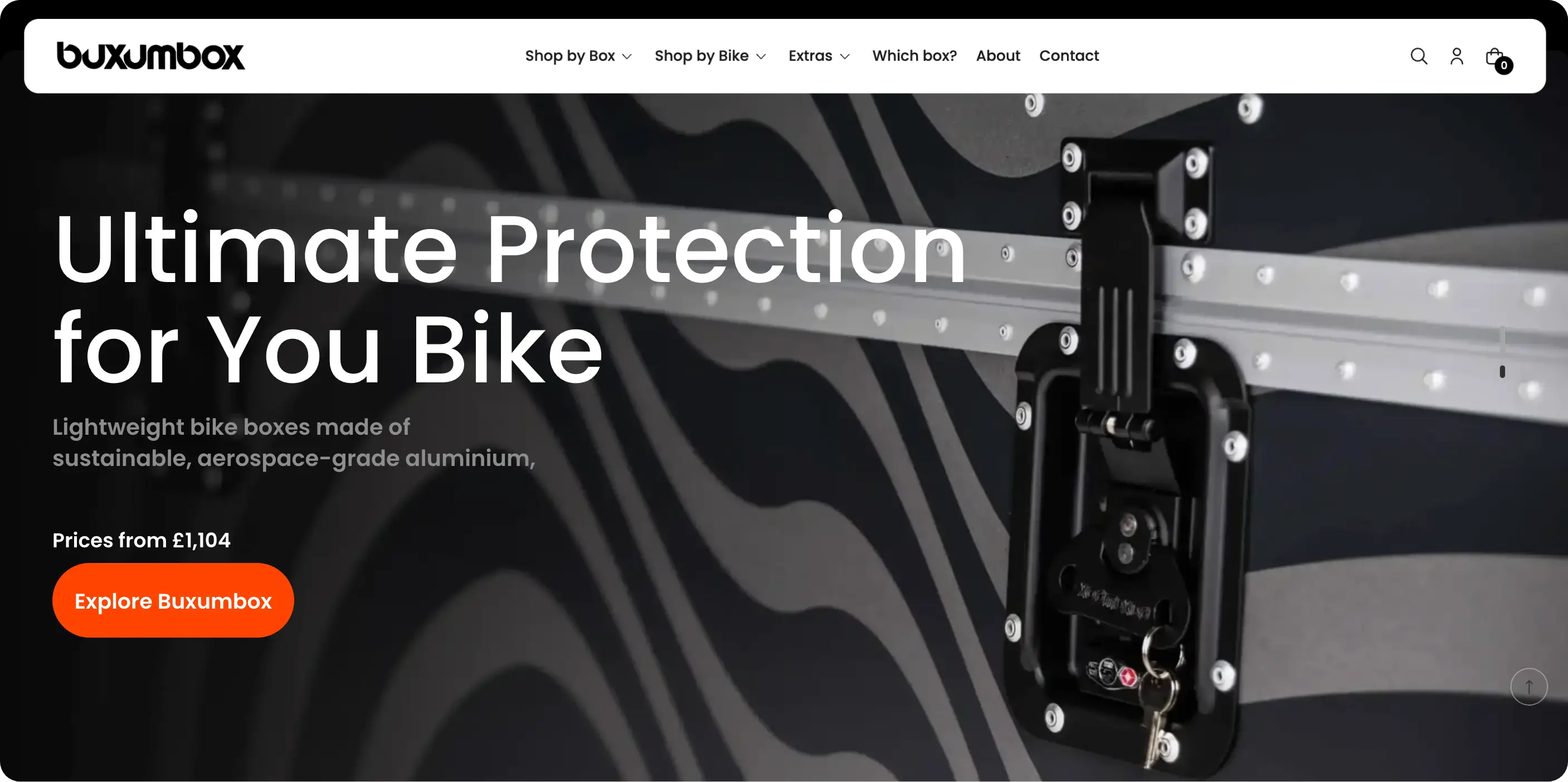
Letting the numbers speak
One month post-launch, the direction was already clear.
Put simply: a complex, configurable product now feels simple to buy. That's just one part of the migration prize, and it's already showing up in the trading data.
Luke Green - Inspira Co-Founder
- Annual growth projected at 35%, up from 21% the previous year.
A meaningful acceleration in Buxumbox’s growth trajectory. - Customer enquiries about option selection down 10%.
The new buying experience was answering questions before customers needed to ask them. - Orders up, with more customers self-serving online.
Fewer phone calls, more completed orders and less admin for the Buxumbox team.
That meant a cleaner checkout, clearer product pages, improved customer confidence and a better buying experience that guides customers through the purchase journey without needing to pick up the phone.
Put simply: significantly improved UX on a stronger ecommerce platform started translating directly into measurable commercial impact.


Making a complex purchase journeys feel simple - is never simple.
On the original WooCommerce site, customers had to fight through the buying journey rather than be guided through it and that means they're not maximising their traffic.
Mike Fryers - Inspira Project Lead
Highly configurable products can test the consumers patience.
On the original WooCommerce site, the product page was overwhelming. Customers were faced with a long list of options, from axle choices and drivetrain through to finish options, bike measurements, nameplate engraving, travel date and accessories.
The options were technically there, but the journey lacked guidance. Additionally it was not aways clear how those selections affected the final price. Unless the customer already understood what was being asked, they had no clear way to move through the decision-making process with confidence.
Many orders were only completed after a phone call, and there was a real risk that others simply gave up before getting that far.
From overwhelming options to a guided purchased journey.
The goal was not to remove the complexity of the product. Buxumbox still needed customers to choose the right size, finish, axle mounts, accessories and travel date. The job was to present those choices in a way that felt calm, guided and easy to complete.
Instead of showing every option at once, we rebuilt the product page around a staged configuration journey.
- The page starts with confidence.
Customers first see the product, price, key benefits, delivery, returns and warranty messaging before they are asked to customise anything. - The options are broken into logical steps.
Size, finish, axle options, bike details, accessories and travel date are handled one stage at a time. - Guidance appears where customers need it.
Helpful content and diagrams support more technical decisions, such as choosing the correct box size. - Only relevant options are shown.
Powder-coat choices, colour options and finish-specific selections appear only when they apply. - Additional costs are made clear.
Customers can see how each selection affects the final price before they confirm it. - Accessories are given proper context.
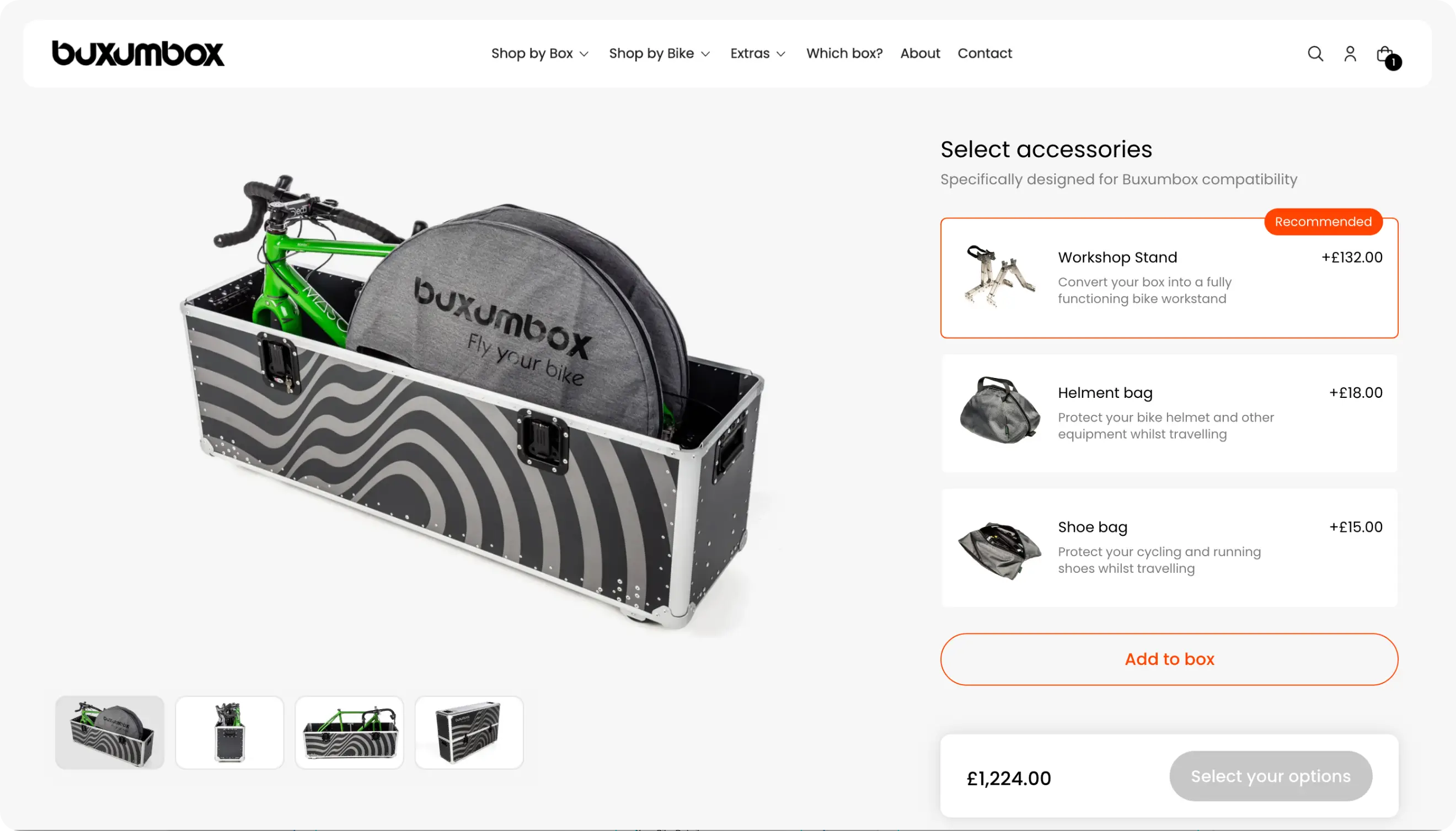
Product images, short descriptions, prices and recommendation badges help customers understand what each add-on is for. - The final configuration is summarised before adding to cart.
Customers can review their chosen configuration and add the complete build to cart in one go.
This turned a long list of product options into a guided buying journey that helps customers make the right decisions with more confidence.
Where complexity showed up
Not every challenge came as a surprise. Some were known from the start, while others only surfaced once the configurator was being built and tested against real product data.
That is often the reality with highly configurable products: the complexity is not just in the design, but in how every option, price, dependency and edge case works together.
- Shopify’s variant limits needed a considered workaround.
With so many possible combinations, native variants alone were not enough. We used line item properties alongside variants to keep the configuration flexible without overloading the product setup. - Shipping logic needed a custom workaround.
Due to the size and weight of the product, international shipping costs needed to vary by variant, which Shopify does not support natively. We solved this with a custom setup using Bespoke Shipping, ensuring the right shipping costs were applied without adding friction to the buying journey - The configurator needed several rounds of iteration.
The order of choices, defaults and supporting content all had to be shaped around real product knowledge. Working closely with Buxumbox, we refined the journey so customers were guided through each decision in the most logical way. - QA revealed edge cases in the purchase journey.
Our QA process surfaced configuration scenarios that needed further testing and refinement, which meant more late-stage work than originally expected. - The launch plan needed to flex.
Where testing stretched the timeline, we worked with Buxumbox to protect build quality rather than rush towards a launch date.
How we delivered
Migrations are always a team effort. Buxumbox brought the product knowledge; we brought the ecommerce strategy and execution.
Mike Fryers - Inspira Project Lead
This was always going to be more than moving products from one platform to another. Every product customiser comes with its own quirks, rules and edge cases, so the buying journey had to be shaped around Buxumbox’s product, not forced into a one-size-fits-all approach.
Working closely with Buxumbox, we combined their product knowledge with our ecommerce experience to refine how customers choose and order a box. That meant improving the decision flow, adding guidance around key options and testing edge cases extensively.
With a product this bespoke, some friction during the build was expected. The priority was making the final experience right, not simply launching fast.

And the launch 🚀
The real success wasn’t simply launching. It was giving customers the confidence to purchase a highly configurable box without reaching for the phone.
The configurator didn't just go live. It worked exactly as intended and from the get go customers were reaching the right configuration on their own, without needing to phone or email.
The friction it took to get there was just the part of the process. Through asking the right questions, involving customers, the client and leaning in our own experience of what patterns work. We were able to validate the customer experience flows to be as intuitive as possible - and the live results validated the effort..
The takeaway
It would be over stated to say that WooCommerce failed Buxumbox. But the experience of running the store on that platform for them was one of complexity, incompatible plugins and a feeling the core had got away from them. Buxumbox didn't just need an improved purchase experisnce, they needed an ecom operating system that made sense. One that provided simplicty, standardisation and a sound foundation for future growth.
Shopify gave them those rails.
The results: better UX, on a stronger platform, translating directly into direct commercial impact. Fewer support enquiries, more self-served orders, and a growth rate that's nearly doubled year-on-year.
Thinking about a migration to Shopify? Learn more in our Shopify Migration Guide.
We help you make sure it's a move that you thrive, not just survive
Frequently asked questions
How can migrating to Shopify improve the customer buying experience?
A migration is an opportunity to modernise your storefront. It starts with reviewing what works, identify where customers are struggling and reset the buying experience around both best practice and real user data. While that work could be carried out on any platform, Shopify makes it quicker and easier to build, test and refine a more intuitive journey.
For Buxumbox, that meant replacing a long and overwhelming list of product options with a guided, step-by-step configurator shaped around how customers actually choose and order a box. Customers now see relevant options in a logical order, understand how each choice affects the price and can review their full configuration before purchasing.
Is Shopify suitable for complex or configurable products?
Yes, although complex products usually need a carefully planned setup rather than a one-size-fits-all solution. For example, Buxumbox customers choose from different box sizes, finishes, axle mounts, colours, accessories and other specifications. With the right strategy and execution, Shopify is more than capable of supporting highly configurable products that are not only easy for customers to purchase, but also straightforward for internal teams to manage.
What are the challenges when migrating a highly customised product builder to Shopify?
Highly customised product builders are rarely a straightforward lift and shift. Every configurator has its own rules, dependencies, pricing logic and edge cases, so the first step is understanding what needs to be preserved, what should be improved and how the experience should be rebuilt within Shopify.
For Buxumbox, that meant rethinking how customers selected box sizes, finishes, axle mounts, colours and accessories, while also working around Shopify’s native variant and shipping limitations. The result was not simply a recreation of the old WooCommerce setup, but a more guided buying journey that was easier for customers to complete and simpler for the Buxumbox team to manage.
What are the most common reasons brands migrate from WooCommerce to Shopify?
Brands often move when their WooCommerce store has become difficult to maintain, overly reliant on plugins or increasingly fragile as the business grows. For example, Buxumbox had reached this point, with more than 40 plugins creating complexity and making routine updates feel risky. Shopify gave the team a more stable and standardised foundation.
What are the wider business benefits of migrating from WooCommerce to Shopify?
The value of a migration goes beyond an immediate uplift in sales. It can remove the technical and operational friction that limits growth, give internal teams greater control and create a more dependable platform for future development.
For Buxumbox, the move replaced a fragile WooCommerce store reliant on more than 40 plugins with a stable, streamlined Shopify setup. The team can now manage the store with greater confidence, customers can complete complex orders without assistance, and the business has a stronger foundation to support its next stage of growth. Within the first month, projected annual growth had increased from 21% to 35%.